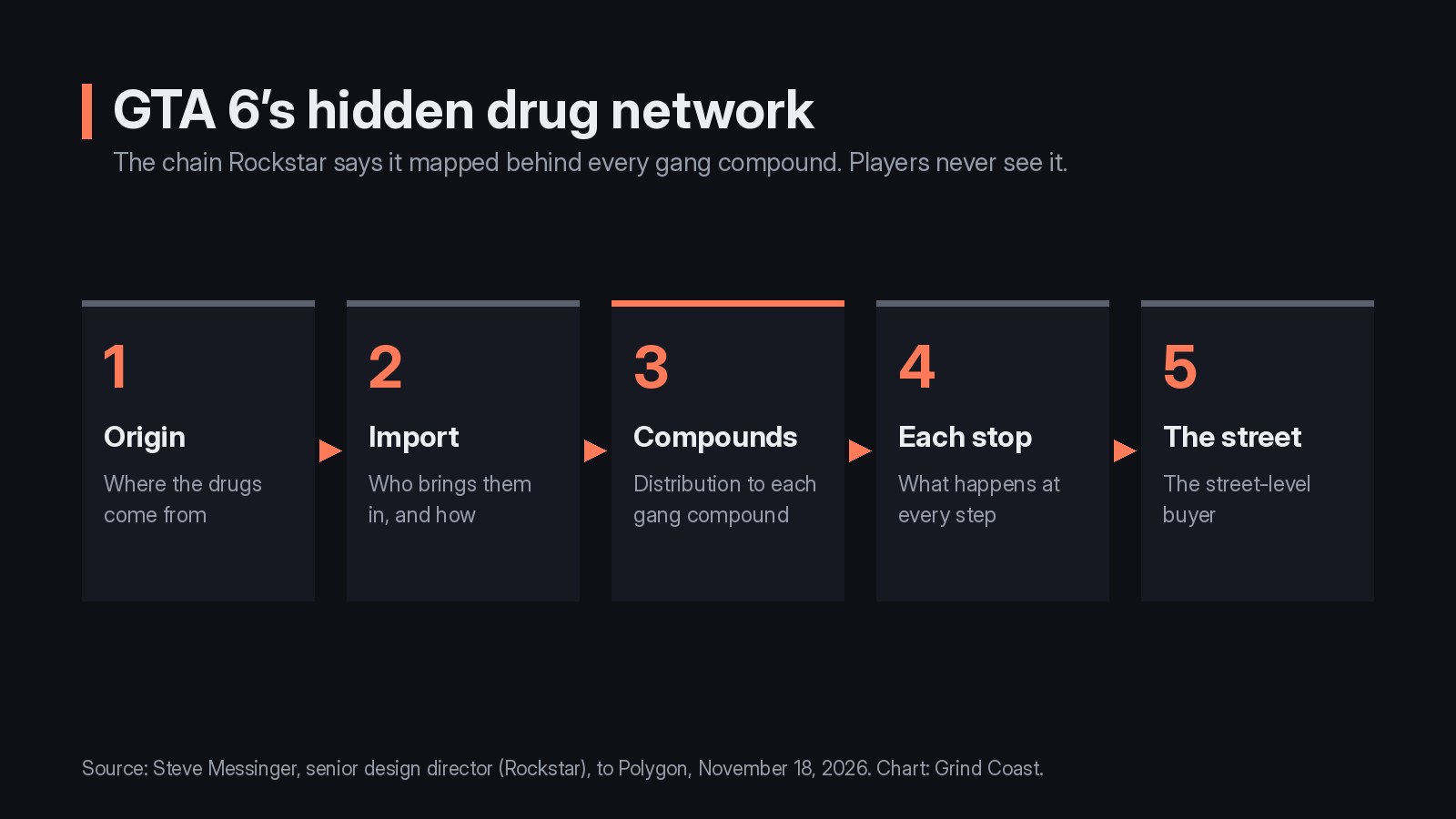
Behind every gang hideout in GTA 6 sits a supply chain the player will probably never see. Steve Messinger, Rockstar’s senior design director for the open world, told Polygon on November 18, 2026 that the game’s gang compounds have “a complex drug network we’ve fully mapped out: where the drugs come from, who brings them in and how, how they’re distributed to each compound, what happens at each stop, and how they eventually reach the street-level buyer.” The game never mentions it, and Polygon notes it may be impossible to track. It is one of the clearest examples yet of how far Rockstar has pushed its world simulation.
What Rockstar has built
The network is a background system, not an activity. Messinger describes five links in the chain, from the origin of the product to the last sale on the street, and each gang compound is a node in it. What the player handles directly is far more limited: as already known before launch, GTA 6 includes consumables such as cocaine that can be carried and used for a temporary boost to health or stamina. The network explains where that stock comes from in the fiction; it is not a business the player runs.
Why simulate what nobody sees
Rockstar knows players will not see the nuts and bolts, Messinger told Polygon, but the studio considered the work necessary anyway, because it “helps everything feel more real, like this big machine is always running even when players aren’t there.” This is a long-standing principle of open-world design: a world that keeps working when the player looks away produces more believable situations when the player looks back. A compound’s guards, its stash and its comings and goings follow from the system, instead of being placed by hand for the player’s arrival.
The characters who run it
The network relies on GTA 6’s population, which Rockstar treats as a project of its own. Polygon reports that an entire team is dedicated to NPC behavior, and that the generation system draws on more than 600,000 bespoke animations across a wide range of body types and clothing styles. Lines of dialogue are recorded in several registers to match the situation. Valmor Garcia, senior technical art director, describes these characters as “fully fleshed out characters with singular awareness and visual identities,” driven by moods and personalities, and “visually on par” with Jason and Lucia.
How encounters come and go
The same philosophy governs scripted encounters. Speaking to Destructoid, Messinger counts more than 1,000 open-world encounters, handled by several ambient-focused teams, and a content tracking system measures how much of each event a player actually sees before deciding whether it can spawn again.
| What you do | What happens next |
|---|---|
| Drive past, hear one line | Short cooldown, then it can spawn again |
| Stop, watch or listen, then leave | Much longer cooldown; after a few times, it stops appearing |
| Interact fully | Flagged to never spawn again |
| Witness a one-of-a-kind scene | Gone after a single sighting |
Interactive events are one-and-done once completed, while some recurring characters come back with new dialogue each time. Ghyan Koehne, senior design director for exploration and ambient content, adds a further layer of hidden content: places that only reveal something at night or on a return visit, and some that send the player across several locations.
Dan Van Zant, senior design director of world and population, sums up the aim: behavior, dialogue and reactions that “often blur the lines” between the base population, ambient events and fully custom content. Stephen Donkin, vice president of design, hopes players will “stop thinking in tasks, completion percentages, online guides” and let the game unfold at its own pace. The drug network belongs to the same approach: a layer of the world that exists whether or not anyone is watching.
Our read
For players, the network changes nothing you have to manage, but it changes how the world behaves. Gang territory should feel inhabited and consistent rather than staged, which matters most when a robbery or a chase takes you through it: expect resistance to come from a system, not a script. The encounter rules also argue for curiosity, since a scene you only glance at can return later, while one you complete is gone for good. Before going near a compound, read our police guide to understand how a wanted level builds, and our robberies guide for the jobs that send you into hostile ground.
What we don’t know
Rockstar has not said whether players can disrupt the network, for example by hitting a compound, nor whether any part of it affects prices, gang strength or territory over time. Polygon’s own conclusion is that the system may be impossible to track from the outside, and no reviewer has yet described seeing it at work.
Frequently asked questions
Can you see the drug network in GTA 6? Not directly. According to Messinger, it runs in the background and the game never explains it; its effects show up in how compounds and their occupants behave.
Can you run your own drug business? Nothing in Rockstar’s statements describes one. The drugs the player can carry are consumables with temporary effects, according to Polygon.
Who is Steve Messinger? A senior design director at Rockstar. Polygon credits him with GTA 6’s open world as a whole, Destructoid with its open-world events.
Do random events repeat? It depends on how you react, according to Rockstar: a quick glance brings an event back later, a full interaction removes it for good.
Updates
November 18, 2026, 21:28 (Brussels time): article published.
Sources
- Polygon, GTA 6’s Hidden Drug System Is Surprisingly Deep
- Destructoid, GTA 6’s best main character may be its setting, thanks to a wild variety of highly unique NPC interactions (describes open-world encounters)
Checked · Published